
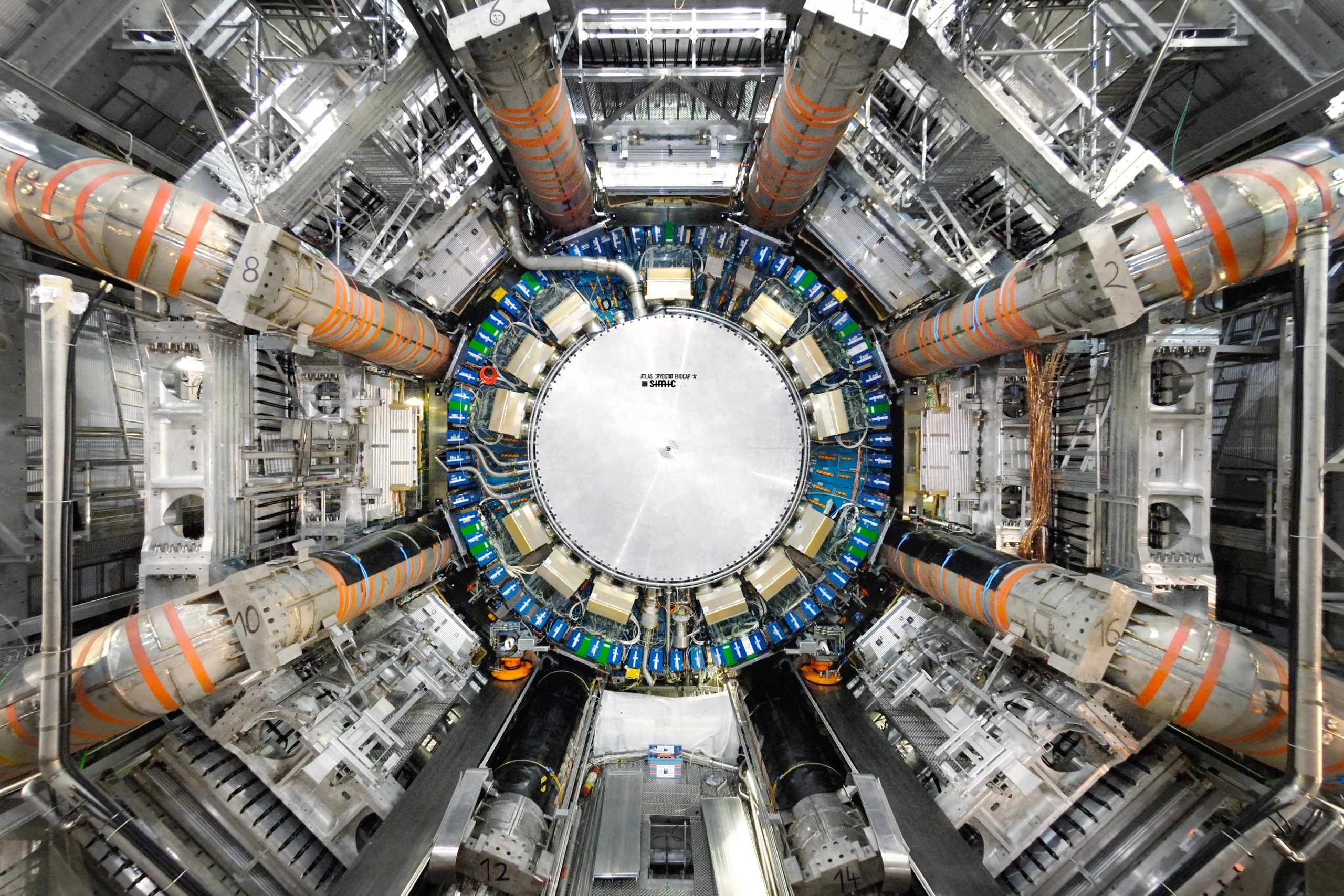
Particles left behind by decaying Z bosons reveal strong evidence of quantum entanglement at CERN’s Large Hadron Collider.
Z bosons, heavy elementary particles that decay almost as soon as they form, leave behind clues to a connection that can outlast physical separation. Known as quantum entanglement, this connection links particles’ quantum properties so that measuring one reveals information about the other, even when they are far apart.
An international team, including physicists at the University of Oxford, has found strong evidence of entanglement between pairs of Z bosons using the ATLAS experiment at CERN’s Large Hadron Collider near Geneva, Switzerland. Published in Physical Review Letters, the findings represent one of the highest-energy confirmations of entanglement ever recorded, extending its study to particles that exist only fleetingly under extreme conditions.
Study co-author Professor Alan Barr, of Oxford’s Department of Physics, said, “We’re used to thinking of entanglement as something delicate, seen in laboratory experiments with single photons. Finding it alive and well among particles as heavy and short-lived as Z bosons, created in some of the most violent collisions we can produce on Earth, shows just how fundamental and robust this quantum effect really is. It’s a nice reminder that the same strange rules of quantum mechanics that may one day power quantum computers are at work everywhere in nature, even at the extreme energies of the Large Hadron Collider.”

Tracing entanglement after Z bosons vanish
The Z bosons in this study came from the decay of Higgs bosons, the particles discovered at the LHC in 2012. To produce Higgs bosons, the collider smashes together protons traveling at 99.99% of the speed of light, with collision energies of 13 trillion electron volts.
The researchers followed a decay process in which a Higgs boson produces two Z bosons, each of which then decays into a pair of electrons or muons. Muons are particles similar to electrons but heavier. Although the Z bosons disappear almost instantly, ATLAS can precisely track these longer-lasting products of their decay.
The angles at which the electrons and muons emerge carry information about the original Z bosons’ spins, a quantum property related to angular momentum. By reconstructing those angles, the team could infer the spins and test whether they were linked through entanglement. This allowed the researchers to investigate the quantum relationship between particles that had already vanished.

From photons to entangled top quarks
Entanglement has previously been demonstrated with photons, electrons, and trapped ions. Albert Einstein famously described it as “spooky action at a distance,” but testing it in massive, rapidly decaying particles requires a different experimental approach.
Barr, who helped construct the LHC, was among the first to propose using particle colliders to investigate entanglement at energies far beyond those of earlier tests. He recognized that an instrument built to discover particles could also probe their quantum behavior. His ideas informed a 2023 ATLAS experiment that demonstrated entanglement between pairs of top quarks, the heaviest known elementary particles. The Z boson measurement expands that work to another kind of particle.
Quantum tools could reveal new physics
These collider experiments also draw on quantum information science, the field behind quantum computing. Entanglement allows multiple qubits, the basic units of quantum information, to be manipulated in a single operation rather than individually, supporting parallel calculations. It also underpins emerging approaches to highly secure quantum communication networks and new generations of sensors.
Physicists are adapting ideas and tools from that field to analyze collider measurements more sensitively. Such methods could reveal subtle effects that point beyond the current understanding of particle physics.
Larger data sets will give researchers more opportunities to apply those techniques. Oxford researchers are helping upgrade the ATLAS detector, which will work alongside the upgraded High-Luminosity Large Hadron Collider. Together, the improvements are expected to support more detailed investigations of quantum phenomena and provide huge volumes of data for new quantum information methods to analyze.
Professor Daniela Bortoletto, of Oxford’s Department of Physics, coordinates the UK effort to produce modules for the upgraded ATLAS detector’s pixel system. She said, “This measurement demonstrates the scientific power of the ATLAS collaboration and the unique capabilities of CERN’s Large Hadron Collider. Oxford researchers have played a leading role in developing these new approaches to studying quantum phenomena at the highest energies, and we are proud to contribute to an international effort that is opening new ways to explore the fundamental laws of nature.”
The measurements also raise questions about how to interpret quantum mechanics. At Oxford, Barr co-leads an interdisciplinary project that combines experimental tests at the smallest scales and highest energies with philosophical investigations of what those tests reveal about reality.
Project co-principal investigator Professor Chris Timpson, of Oxford’s Faculty of Philosophy, said, “Entanglement is both the most promising and the most puzzling aspect of quantum reality; these collider experiments detecting entanglement present a new frontier in investigations of the foundations of quantum mechanics.”
Reference: “Measurements of Z-Boson Pair Entanglement in Decays of Higgs Bosons at the ATLAS Experiment” by G. Aad, E. Aakvaag, B. Abbott, S. Abdelhameed, K. Abeling, N. J. Abicht, S. H. Abidi, M. Aboelela, A. Aboulhorma et al. (ATLAS Collaboration), 11 September 2026, Physical Review Letters.
DOI: 10.1103/y1nh-1b82
Never miss a breakthrough: Join the SciTechDaily newsletter.
Follow us on Google and Google News.
6 Comments
Einstein Called It “Spooky.” CERN Just Found It at Extreme Energies at the Large Hadron Collider.
VERY GOOD.
Researchers need to think deeply:
1. Is the phenomenon you’ve discovered related to the equipment you’re using?
2. Is what you’re observing purely a feature of nature itself, completely independent of your apparatus?
These are two questions that modern physics cannot avoid and must confront.
A Reflection for the Researchers at CERN:
You have invested vast resources and accumulated a wealth of data. Yet, one is compelled to ask: are your current interpretations of these results truly grounded in objective science?
Consider this analogy: viewing the world through lenses of different colors yields vastly different perceptions of reality. How can you claim to know which view is the absolute truth, independent of your observation? If you were to don a pair of opaque lenses, would the world itself simply cease to exist? If mainstream physics finds these questions too difficult to resolve, perhaps it should seek answers in the unburdened intuition of children.
For further context, you might wish to examine this discussion: https://scitechdaily.com/1000x-speedup-scientists-just-broke-through-a-major-quantum-computing-bottleneck/#comment-1034842. While access to such external critiques may be restricted within your institutional network, the Chinese version at https://zhuanlan.zhihu.com/p/701032654 remains accessible. It would be regrettable if such channels were to be blocked.
The reality is that, regardless of intent, your current approach appears to the public as a form of avoidance—much like an ostrich burying its head in the sand. It is important to emphasize that this is not a reflection on the personal integrity of individual researchers, but rather a consequence of the self-imposed rules and group dynamics within the academic community. The irony lies in the stark disconnect between the scientific community’s self-perception and how it is viewed by the outside world. One is left wondering if the absurdity of the current situation has inadvertently become an accepted dogma within your circle.
“At the TeV scale of the Large Hadron Collider, you are pushing past ordinary atomic interactions and forcing energy inputs high enough to stress the local ‘frame’—testing the limits of nuclear binding and the strong force itself. The fact that quantum entanglement survives those extreme environments tells us something profound: the underlying medium or topological connection doesn’t just snap under high-energy stress.
In standard particle physics, gluons are the exchange particles of quantum chromodynamics that bind quarks together. When CERN cranks up the LHC to those extreme energies, you are directly stressing and probing that gluon field. The survival of entanglement under that intense stress proves that the underlying structural ‘glue’ doesn’t dissolve under pressure; field lines and topological connections maintain their integrity even when you’re pumping in enough energy to tear standard hadronic interactions apart.
It points straight back to continuous medium mechanics: the fabric holding these states together operates at a deeper level than local particle exchanges, reinforcing the idea that space and field states maintain underlying continuity even when pushed to the breaking point.” The Link , https://docs.google.com/document/d/1TIuQESrA-mJao6h7rBiv_sXv_DjDAJbPEnGQJxh9IaQ/edit?usp=drive_link
Think of a line drawn mirror image on both sides of a sheet of paper. Flex the paper so that a wave forms, causing the line to rise and fall at each end concurrently. Easy, yes? Now, draw a circled ‘P’ (particle) on one side of the line. Next, extend the line 10 billion LY in either direction, and imagine another circled ‘P’ on the opposite side of the paper.
The wave affects both particles concurrently via the wave. The wave determines the state of both, not needing velocity or time to transmit information about the state of either particle. No laws broken, no ‘Pretendium’ needed, no spooky action at a distance. The wave? A function of the singularity at the beginning of the Universe, played out in whatever value of dimensions your theory requires.
Try this experiment yourself, today! It really is this easy!